
Case Studies – Lean

How the most heavily modelled account we’d inherited was hiding a 43% gain.

How the most heavily modelled account we’d inherited was hiding a 43% gain.

Case study · B2B SaaS · Self-serve signup · Google Ads and Performance Max

The machines were doing a great job. The inputs underneath them didn’t match the business.

The short answer

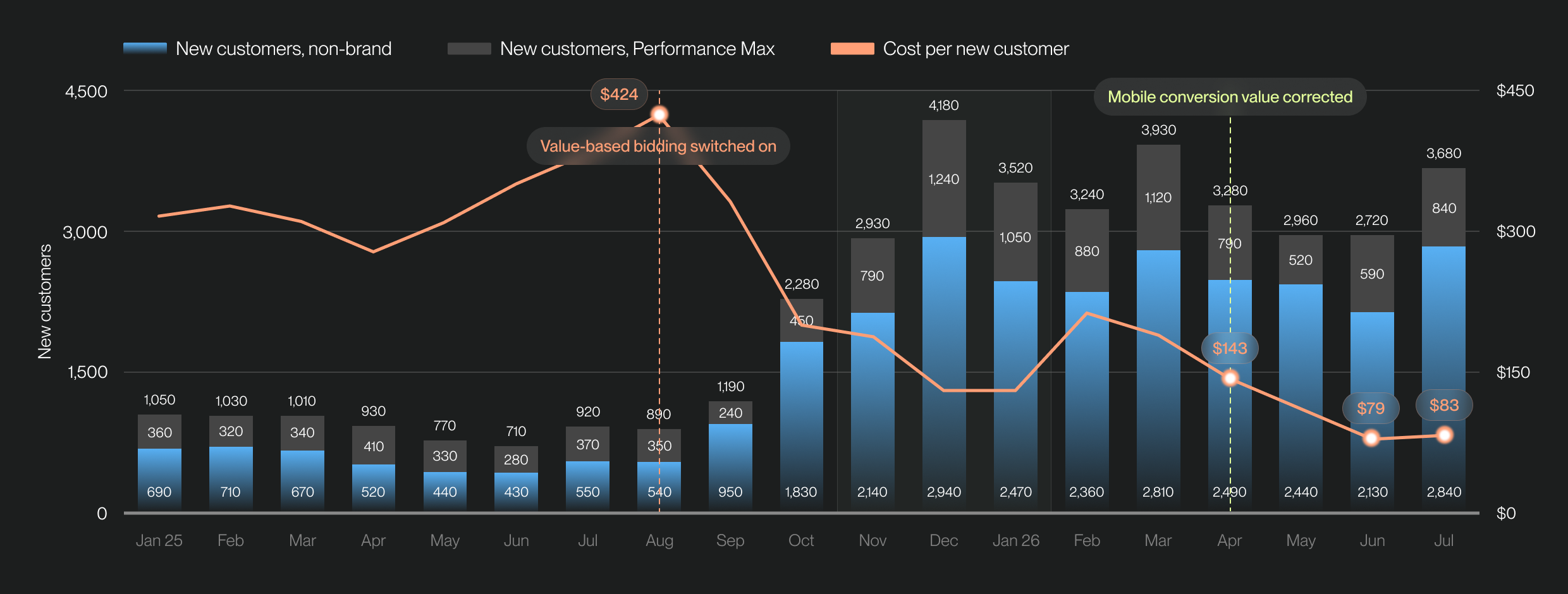
A B2B SaaS platform spending around half a million dollars a month handed us one of the more heavily modelled bidding setups we’d taken over. Value-based bidding since the previous August, on a prediction model reading hundreds of signals. All of that was the right call. What none of it could do was check its own inputs. The value assigned to mobile conversions didn’t match what mobile signups were worth downstream. We adjusted it in April 2026, and by June cost per new customer was down 48% on Performance Max and 43% on non-brand search, the lowest in nineteen months.

~$500K

Monthly paid media spend

−43%

Cost per new customer, $143 to $81

April 2026June and July 2026Change
Cost per new customer, non-brand$138$78 to $83−40 to −43%
Cost per new customer, Performance Max$157$82−48%
First-month cohort ROAS, non-brand0.05x0.09 to 0.10x2x
First-month cohort ROAS, Performance Max0.04x0.09 to 0.10x>2x

Wasn’t the model supposed to catch this?

Fair question, and the answer matters. The automation wasn’t the problem. An account this size can’t be run without it, and running paid media now without every model you can get is money left on the table.

You can see it working on the chart. Value-based bidding went live in August 2025 and cost per new customer fell from $424 to $130 by December. That was the client’s own move, before we arrived, and it was the right one.

But a model can only bid on the values it’s given. It can’t know when one of them is wrong, because the proof sits in back-end data it never sees. Someone has to bring that number to it.

The model wasn’t wrong. It was optimising accurately toward a value that didn’t match the business.

Who this is about

A B2B SaaS platform with a self-serve signup and a usage-based product. Someone signs up, connects their systems, makes a first purchase, and if the product fits they keep buying for years. That first purchase is where a signup becomes a real customer, so the account is judged on it alongside transaction volume and cohort user counts.

We took the account over in April 2026. ROAS on this page means first-month cohort revenue divided by acquisition spend, which is a leading indicator in a business where value accrues over years, not a payback figure.

What made the difference

We audited what the model had been told, not how it was tuned

The instinct with an underperforming automated account is to tune it. Adjust the targets, add another tool, restructure the campaigns. We went the other way and looked at the inputs.

Put the platform’s valuation next to the business’s own outcomes, segment by segment, and look for where the two disagree. That’s the method. We ran it across first purchases, transactions and cohort users, broken out every way the account could be split. In one dimension the two had been disagreeing for months. Here it was device. In another account it could be geography, landing page or time of day.

The fix was a value adjustment, not another tool

Mobile conversions were being priced as though they were worth what desktop ones were. The back-end numbers said otherwise, so we adjusted the value assigned to mobile and let the model reallocate on its own. No restructure, no new platform, no extra layer. One correction to a price the system had been carrying since before we arrived.

The model optimises. Someone still has to decide what it’s optimising toward.

Did that cost us volume?

No. July 2026 brought in roughly as many new customers as March 2026 did, on around 40% of the spend.

The June and July figures aren’t only better than April either. They’re the best in the whole nineteen-month series. Combined cost per new customer had never gone below $130 before, and that came in December and January, the peak of the season. June and July beat it in the quiet months.

Questions we get asked

Should we be running more automation or less?

It depends on how rich your signals are. If you have a lot of them, and they’re varied, use as much value-based bidding and predictive modelling as you can get, because that’s where the compounding is. If the data is thin, more modelling on top won’t invent signal that isn’t there. One thing worth knowing either way: a platform’s own model can only work with what you can feed it. In this account a separate model was used because there was no way to get every signal into Google’s.

Can a value-based bidding model find every optimisation on its own?

No. A model reading hundreds of signals ranks and bids inside the values it’s been given. It can’t tell you that one of those values is wrong, because the evidence for that sits in back-end data the platform never sees. Here a heavily modelled setup ran for months while one conversion value stayed mispriced, and correcting it was worth 40 to 48% of acquisition cost.

How do you find a gap like this in an account that’s already modelled?

Put the platform’s valuation next to the business’s own outcomes, segment by segment, and look for where the two disagree. The model is only as good as what it’s been told each conversion is worth, and it has no way to audit that input. In this account the disagreement showed up on device. In the next one it could be geography, landing page or time of day.

What does a person add to an account already running advanced automation?

The judgment about what the machine should be aiming at, and the work of connecting paid media to business outcomes. Models and third-party tools find patterns inside a defined objective very well. They don’t audit whether the objective matches the business, because that means comparing platform behaviour against revenue data the platform can’t see. In mature accounts that comparison is where most of the value left on the table sits.

Client name withheld at the client’s request. All figures are actual reported results for the periods shown. ROAS refers to first-month cohort revenue divided by acquisition spend and is used as a leading indicator, not a measure of payback.

Ivana Janevska

The author

Ivana Janevska

Account Lead and Partner @ Lean

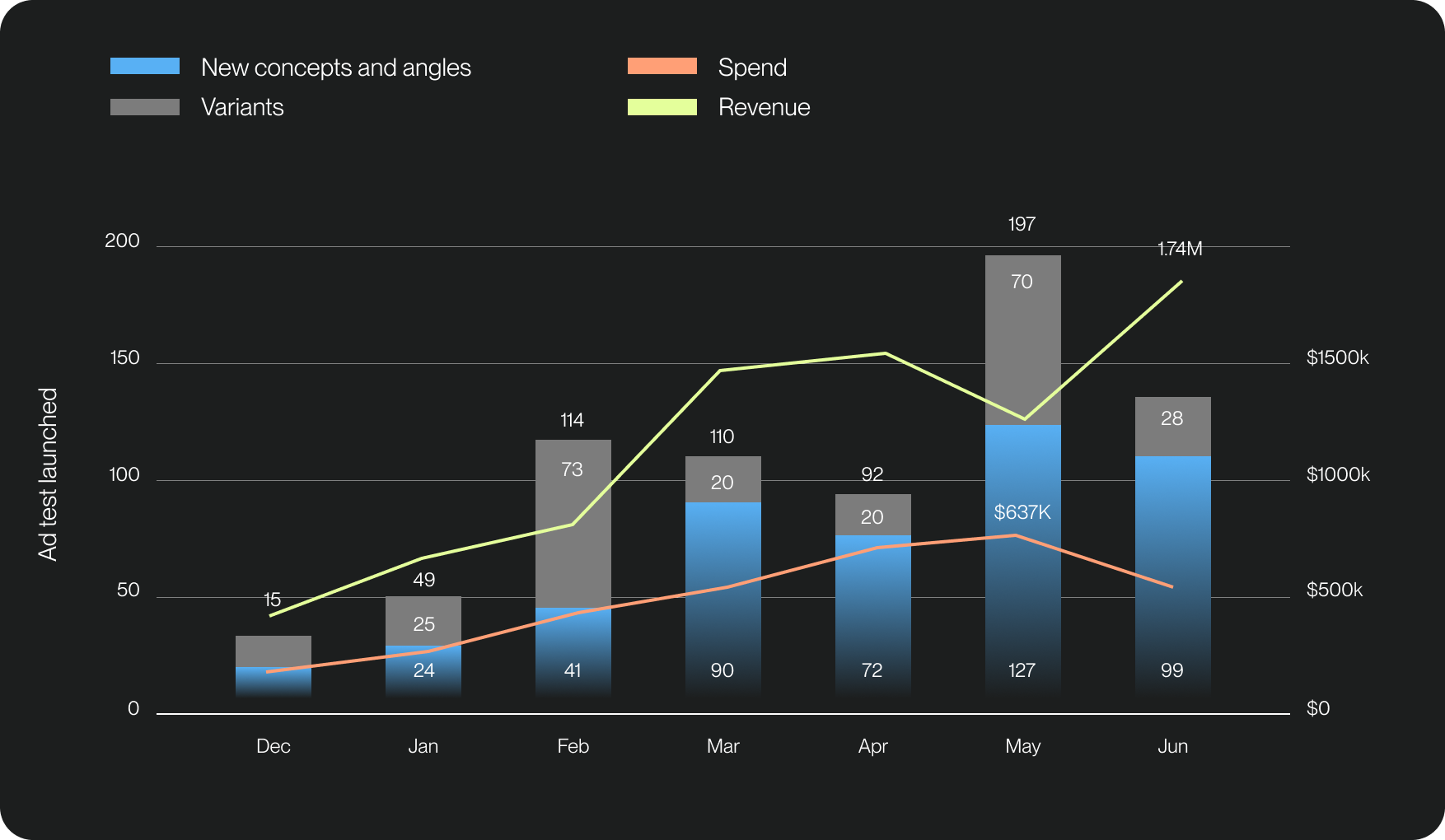
How 704 ad tests took monthly spend 10x with cost per enrollment down 46%

How 704 ad tests took monthly spend 10x with cost per enrollment down 46%

Case study · EdTech · Meta · Performance creative Nobody can pick the winning ad in advance, so we stopped trying to. The short…
We Did Such a Great Job, We Got Fired.

We Did Such a Great Job, We Got Fired.

“The commitment to our company goals was impressive, even if it meant a shorter-term engagement” - Jamie Scarborough, Founding Partner at Sales Talent Agency…
Scaling a telehealth client within 4 years with 30x SEM Growth and 40% higher efficiency

Scaling a telehealth client within 4 years with 30x SEM Growth and 40% higher efficiency

This is the story of how our digital marketing efforts enabled the rapid growth of a telemedicine brand from a startup to market leader,…

We Did Such a Great Job, We Got Fired.

We Did Such a Great Job, We Got Fired.

“The commitment to our company goals was impressive, even if it meant a shorter-term engagement” Jamie Scarborough, Founding Partner at Sales Talent Agency

Sales Talent Agency is a Canadian recruitment company that helps their clients build elite go-to-market teams, whether they are looking to find one key sales role or staff an entire sales team. They get it done the right way, the first time, and maintain one of the lowest replacement rates in the industry at 3%.

LEAN partnered with Sales Talent Agency to help them optimize and scale their B2B side of the business.

Project #1: Customizing the landing page for the B2B audience

Issue: You may have the best keywords, traffic, and most compelling ad copy, but if your on-site experience isn’t tailored to the user journey, you will lose people on the website. Sales Talent Agency functions as both a recruitment agency and a job board. Their B2B page contained a navigation menu which included a “Search Jobs” button leading people to the B2C-oriented job board, and also featured a “Call us today” as a secondary CTA that didn’t align with typical B2B user behavior (companies want a meeting in their calendar, not to just call another company).

We analyzed historical user flow data and saw that although this page had a lot of interaction with the “Search Jobs” and “Call us today” buttons, there was never a Customer that came through those flows.

Solution: We designed a new SEM-specific landing page in a lightweight and fast-launch format, since we wanted to get some insights and gather data before the client makes a bigger investment into a full re-design. The new page featured a few simple modifications:

  • A singular, clear CTA.
  • Removed top navigation bar to reduce click-aways.
  • Headline that communicates a clear value prop and direct benefit to the user.
  • A stock background image that visually communicated a more business setting.
  • Trust elements added as a few short bullet points above the fold.
  • Rotating logos of companies they’ve worked with.
Results from Project #1: The new Landing Page brought 2x more leads, and had an almost 200% higher Lead conversion rate.

Project #2: Further refining the Landing Page experience

Issue: As a part of the landing page testing process, we introduced a heatmaps tool which helped us uncover another weak point in the landing page experience – the proactive Chat Bot. Looking at both the desktop and mobile recordings of the homepage, there were obvious hotspots on the “x” command indicating that people disliked the chat bot and were closing it.

In addition, the chat bot was following the same Lead generating flow as the old page, leading people to the Job Board if they said they were “looking for a job”; or asking for their email if they said they’re “looking to hire”.

Solution: We wanted to understand more about the chat bot interactions, and see whether it may be driving quality leads. So, we dug into the previous 1 year of chat bot data to uncover the following:

  • 75% of chat bot interactions were people looking for a job (aka not B2B)
  • 20% were looking to hire, but didn’t provide an email address (aka not leads)
  • 5% were looking to hire and provided an email address (BUT 3.5% had a gmail, yahoo, outlook email address, again indicating that they are not high-quality B2B type of leads)

The final suggestion was that the chat bot, in its current form, needed to be removed from the website because it’s driving a lot of B2C interactions as well as “junk” leads when it comes to the B2B segment of the business which Sales Talent Agency wanted to grow. 

Results from Project #2: Removing the chat bot reduced B2C-oriented traffic going to the Job Board from the SEM landing pages, without hurting B2C access via organic paths. It was a win-win for the user experience on the website.

Project #3: Scaling, but with the right company type

Issue: We didn’t have issues when it came to scaling… (just look at the chart below)

…but, the issues arose while closely monitoring the lead quality. There were increasingly more Leads coming from small Companies, or Companies looking to hire commission-only sales people that didn’t have a guaranteed annual salary, all of which would be considered a low quality lead for Sales Talent Agency. 

Solution: We didn’t want to continue scaling Leads for just volume over quality. We needed to teach Google’s algorithm who’s the right kind of lead for us. Previously within Google ads, we had one event that tracked conversions whenever someone successfully filled out the lead form following the “Hire a sales person” CTA button, and it didn’t matter who filled out that form.

So, we worked with Sales Talent Agency’s developer team to engineer a dual flow that would indicate the Lead quality, and enable us to only train Google’s algorithm to optimize on the higher quality leads. Here’s the logic of how the flows were constructed:

Results from Project #3: After engineering the new flow, we set up new conversion tracking events, which would allow us to optimize on the High quality leads conversion events.

Project #4: Sorting out the business-level backend data

Issue: This was one of our first focus areas when we started working with Sales Talent Agency. We asked for access to the backend data from the client to understand the cross-channel mix, and what each initiative is driving for the business. 

What we found was that there was one lumped group called simply Google which was driving the majority of the revenue for the business. The problem was that this group didn’t distinguish between google organic, google paid traffic, or direct traffic as separate sources.

Solution: The solution was as simple as a walk in the park. We needed UTM parameters to append to the paid ads URLs and the client was going to be able to tell apart the two channels in the backend.

Results from Project #4: WE GOT FIRED (and also got a 5-star review from the client)!
In fact, this was one of our earliest fixes — proper UTM tracking — which helped reveal that it was Organic and Direct traffic sources that drove real customers. Aside from the obvious improvements we made in the following months, it was this insight that ultimately saved tens of thousands in wasted ad spend and helped Sales Talent Agency rethink their entire marketing mix (aka no need for an agency to be managing their paid ads efforts)

The real result for LEAN was a happy client who praised us for being focused on the bottom-line of their business, and that we ultimately left their business in better condition than we found it. For comparison, there was another agency that was previously managing their campaigns for over two years and never thought to dig just a little bit under the surface to find tons of opportunities that can improve the business.

That’s why 100% of LEAN’s clients come from recommendations.

Ivana Janevska

The author

Ivana Janevska

Account Lead and Partner @ Lean

How the most heavily modelled account we'd inherited was hiding a 43% gain.

How the most heavily modelled account we'd inherited was hiding a 43% gain.

Case study · B2B SaaS · Self-serve signup · Google Ads and Performance Max The machines were doing a great job. The inputs underneath…
How 704 ad tests took monthly spend 10x with cost per enrollment down 46%

How 704 ad tests took monthly spend 10x with cost per enrollment down 46%

Case study · EdTech · Meta · Performance creative Nobody can pick the winning ad in advance, so we stopped trying to. The short…
Scaling a telehealth client within 4 years with 30x SEM Growth and 40% higher efficiency

Scaling a telehealth client within 4 years with 30x SEM Growth and 40% higher efficiency

This is the story of how our digital marketing efforts enabled the rapid growth of a telemedicine brand from a startup to market leader,…

Scaling a telehealth client within 4 years with 30x SEM Growth and 40% higher efficiency

Scaling a telehealth client within 4 years with 30x SEM Growth and 40% higher efficiency

This is the story of how our digital marketing efforts enabled the rapid growth of a telemedicine brand from a startup to market leader, scaling conversions on SEM by 2,985% over the course of 4 years while improving the efficiency by 40%.

In this article, we share the top 5 strategies we used to drive 15% YoY growth even in 2022, despite the challenges of post-covid drop in demand and increase in competition.


Client Overview

Our client is a nationwide virtual primary care provider that offers a quick and simple alternative to traditional health care. With board-certified doctors licensed in all 50 states and high ratings in app stores, they’re on a mission to help everyone live longer, healthier and happier lives.


SEM Growth Throughout the Years

Source: analytical data obtained via Google Ads, 2019 – 2022


2019:  +130% Conversions  |  +35% Spend  |  -40% CPA

“The year we took over the account.” — Immediately we started to focus on optimization and efficient expansion. This resulted in over 100% customer base growth at 40% lower cost per customer compared to 2018. Mainly, the strategies that got us there were better traffic control and orchestrating the user’s keyword-ad-landing page flow which led to 97% CvR boost.


2020:  +440% Conversions  |  +390% Spend  |  -10% CPA

“The year Covid hit.” — In March 2020 the world changed, and so did the telehealth industry. The natural demand for our existing core keywords grew exponentially, but we also drove significant incremental volume by retesting all the keyword themes that didn’t perform in the past. For many initiatives, we finally had enough volume to build more granular structures and further customize the user flow.


2021:  +100% Conversions  |  +165% Spend  |  +30% CPA

“The year Covid continued.” — The industry’s increase in demand was followed by an increase in competition that impacted the CPC. Suddenly, we had doctor chats, symptom checkers, and even Amazon entering the playing field. One of our main strategies focused on ad messaging and repositioning ourselves to stand out in the new competitive landscape, as well as doing extensive landing page testing which led to 12% CvR increase.


2022:  +15% Conversions  |  +/-0% Spend |  -15% CPA

“The year Covid ended…” — As of February it seemed like Covid didn’t matter any more. We got the vaccine, several Covid pills, and life was going back to “normal”. Just look at the search demand diving off a cliff on the trendlines below.

Source: publicly available Google Trends data, 2019 – 2022


So, how did we maintain a flat spend and almost 15% customer growth year-over-year?

Let’s dive in!


The 2022 Challenge & Top 5 Strategies for Success

Without Covid, 2022 was going to be a challenge. We needed to identify new pockets of volume that will help us deliver YoY growth, and we needed to do it fast.

So, we rolled up our sleeves and kept them rolled up in order to stay on top of new keyword expansion opportunities. Here’s the anonymized traffic for a few of our key finds:

Source: anonymized Google Trends data of newly identified keyword themes, 2018 – 2022


To identify these much needed volume-drivers we used the following 5 Strategies:

  1. Scraping competitors keyword for any gaps
  2. Tracking the popularity of specific medical conditions
  3. Using internal business data for month-over-month changes in diagnosis and prescription trends
  4. Following FDA medication approvals
  5. Staying on top of seasonal patterns

Then, we just launched fast, optimized faster, and dug for new expansion opportunities again and again.

Needless to say, we continued to focus on optimizations for ad copy and messaging. This time, we perfected the RSA testing strategies, which brought a 15% CTR increase compared to the previous year.

Conclusion

At LeanSEM, experts run your entire PPC operation better than an in-house team. We execute the right ideas faster and better, delivering meaningful results and insights. Our results speak for themselves, and that’s why clients stay in business with us for 5+ years, while the industry average is around 1-2 years.

But, don’t take our word for it…

Testimonial from the client:

The LEAN team’s technical expertise and strategic mindset were crucial for scaling our business over the last few years. The team is highly responsive and reliable, and their performance reports are in-depth, insightful, and consistently accurate. Beyond the day-to-day management of our account, the team is proactive in exploring new ways to drive volume and efficiency in our account. We highly recommend working with LEAN to drive fast growth in performance channels.


Check out the LeanSEM methodology and brand promise here.


Ivana Janevska

The author

Ivana Janevska

Account Lead and Partner @ Lean

How the most heavily modelled account we'd inherited was hiding a 43% gain.

How the most heavily modelled account we'd inherited was hiding a 43% gain.

Case study · B2B SaaS · Self-serve signup · Google Ads and Performance Max The machines were doing a great job. The inputs underneath…
How 704 ad tests took monthly spend 10x with cost per enrollment down 46%

How 704 ad tests took monthly spend 10x with cost per enrollment down 46%

Case study · EdTech · Meta · Performance creative Nobody can pick the winning ad in advance, so we stopped trying to. The short…
We Did Such a Great Job, We Got Fired.

We Did Such a Great Job, We Got Fired.

“The commitment to our company goals was impressive, even if it meant a shorter-term engagement” - Jamie Scarborough, Founding Partner at Sales Talent Agency…
Ivana Janevska

The author

Ivana Janevska

Account Lead and Partner @ Lean

If you found this article useful, be sure to have a look here

How the most heavily modelled account we'd inherited was hiding a 43% gain.

How the most heavily modelled account we'd inherited was hiding a 43% gain.

Case study · B2B SaaS · Self-serve signup · Google Ads and Performance Max The machines were doing a great job. The inputs underneath…
How 704 ad tests took monthly spend 10x with cost per enrollment down 46%

How 704 ad tests took monthly spend 10x with cost per enrollment down 46%

Case study · EdTech · Meta · Performance creative Nobody can pick the winning ad in advance, so we stopped trying to. The short…
We Did Such a Great Job, We Got Fired.

We Did Such a Great Job, We Got Fired.

“The commitment to our company goals was impressive, even if it meant a shorter-term engagement” - Jamie Scarborough, Founding Partner at Sales Talent Agency…
Ivana Janevska

The author

Ivana Janevska

Account Lead and Partner @ Lean

If you found this article useful, be sure to have a look here

How the most heavily modelled account we'd inherited was hiding a 43% gain.

How the most heavily modelled account we'd inherited was hiding a 43% gain.

Case study · B2B SaaS · Self-serve signup · Google Ads and Performance Max The machines were doing a great job. The inputs underneath…
How 704 ad tests took monthly spend 10x with cost per enrollment down 46%

How 704 ad tests took monthly spend 10x with cost per enrollment down 46%

Case study · EdTech · Meta · Performance creative Nobody can pick the winning ad in advance, so we stopped trying to. The short…
We Did Such a Great Job, We Got Fired.

We Did Such a Great Job, We Got Fired.

“The commitment to our company goals was impressive, even if it meant a shorter-term engagement” - Jamie Scarborough, Founding Partner at Sales Talent Agency…
Ivana Janevska

The author

Ivana Janevska

Account Lead and Partner @ Lean

If you found this article useful, be sure to have a look here

How the most heavily modelled account we'd inherited was hiding a 43% gain.

How the most heavily modelled account we'd inherited was hiding a 43% gain.

Case study · B2B SaaS · Self-serve signup · Google Ads and Performance Max The machines were doing a great job. The inputs underneath…
How 704 ad tests took monthly spend 10x with cost per enrollment down 46%

How 704 ad tests took monthly spend 10x with cost per enrollment down 46%

Case study · EdTech · Meta · Performance creative Nobody can pick the winning ad in advance, so we stopped trying to. The short…
We Did Such a Great Job, We Got Fired.

We Did Such a Great Job, We Got Fired.

“The commitment to our company goals was impressive, even if it meant a shorter-term engagement” - Jamie Scarborough, Founding Partner at Sales Talent Agency…
Ivana Janevska

The author

Ivana Janevska

Account Lead and Partner @ Lean

If you found this article useful, be sure to have a look here

How the most heavily modelled account we'd inherited was hiding a 43% gain.

How the most heavily modelled account we'd inherited was hiding a 43% gain.

Case study · B2B SaaS · Self-serve signup · Google Ads and Performance Max The machines were doing a great job. The inputs underneath…
How 704 ad tests took monthly spend 10x with cost per enrollment down 46%

How 704 ad tests took monthly spend 10x with cost per enrollment down 46%

Case study · EdTech · Meta · Performance creative Nobody can pick the winning ad in advance, so we stopped trying to. The short…
We Did Such a Great Job, We Got Fired.

We Did Such a Great Job, We Got Fired.

“The commitment to our company goals was impressive, even if it meant a shorter-term engagement” - Jamie Scarborough, Founding Partner at Sales Talent Agency…
Ivana Janevska

The author

Ivana Janevska

Account Lead and Partner @ Lean

If you found this article useful, be sure to have a look here

How the most heavily modelled account we'd inherited was hiding a 43% gain.

How the most heavily modelled account we'd inherited was hiding a 43% gain.

Case study · B2B SaaS · Self-serve signup · Google Ads and Performance Max The machines were doing a great job. The inputs underneath…
How 704 ad tests took monthly spend 10x with cost per enrollment down 46%

How 704 ad tests took monthly spend 10x with cost per enrollment down 46%

Case study · EdTech · Meta · Performance creative Nobody can pick the winning ad in advance, so we stopped trying to. The short…
We Did Such a Great Job, We Got Fired.

We Did Such a Great Job, We Got Fired.

“The commitment to our company goals was impressive, even if it meant a shorter-term engagement” - Jamie Scarborough, Founding Partner at Sales Talent Agency…
Ivana Janevska

The author

Ivana Janevska

Account Lead and Partner @ Lean

If you found this article useful, be sure to have a look here

How the most heavily modelled account we'd inherited was hiding a 43% gain.

How the most heavily modelled account we'd inherited was hiding a 43% gain.

Case study · B2B SaaS · Self-serve signup · Google Ads and Performance Max The machines were doing a great job. The inputs underneath…
How 704 ad tests took monthly spend 10x with cost per enrollment down 46%

How 704 ad tests took monthly spend 10x with cost per enrollment down 46%

Case study · EdTech · Meta · Performance creative Nobody can pick the winning ad in advance, so we stopped trying to. The short…
We Did Such a Great Job, We Got Fired.

We Did Such a Great Job, We Got Fired.

“The commitment to our company goals was impressive, even if it meant a shorter-term engagement” - Jamie Scarborough, Founding Partner at Sales Talent Agency…
Ivana Janevska

The author

Ivana Janevska

Account Lead and Partner @ Lean

If you found this article useful, be sure to have a look here

How the most heavily modelled account we'd inherited was hiding a 43% gain.

How the most heavily modelled account we'd inherited was hiding a 43% gain.

Case study · B2B SaaS · Self-serve signup · Google Ads and Performance Max The machines were doing a great job. The inputs underneath…
How 704 ad tests took monthly spend 10x with cost per enrollment down 46%

How 704 ad tests took monthly spend 10x with cost per enrollment down 46%

Case study · EdTech · Meta · Performance creative Nobody can pick the winning ad in advance, so we stopped trying to. The short…
We Did Such a Great Job, We Got Fired.

We Did Such a Great Job, We Got Fired.

“The commitment to our company goals was impressive, even if it meant a shorter-term engagement” - Jamie Scarborough, Founding Partner at Sales Talent Agency…